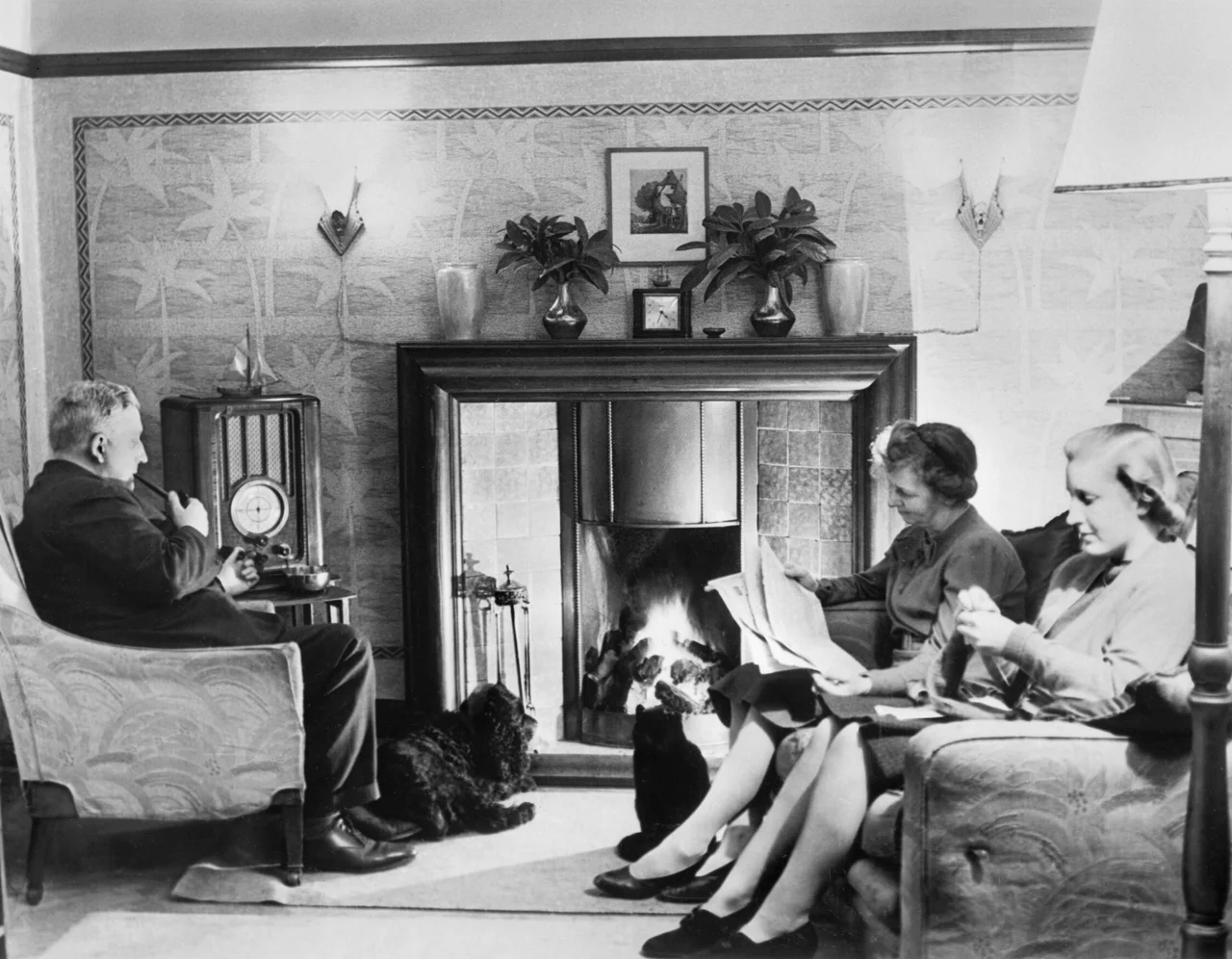
An afternoon at home in Taunton, Somerset, in 1942: family members read, knit and listen to the wireless. Photograph: Ministry of Information Photo Division / Imperial War Museums, D 12274, via Wikimedia Commons. The Commons record identifies the photograph as public domain due to expired Crown copyright.

There’s something about an old radio, isn’t there? The chunky buttons. The dial with all those mysterious numbers. The slightly warm, crackly sound that seems to come with its own knitted cardigan and a cup of tea.
Maybe it’s sitting on your grandma’s kitchen windowsill. Maybe it’s a battered transistor radio in a charity shop. Or maybe, if you’re like me, you’re picturing a group of kids in Stranger Things, clutching walkie-talkies while something absolutely terrible happens in a forest.
Radio is both wildly practical and, somehow, an entire aesthetic. It has helped ships call for help, brought voices into homes during wartime, kept communities informed and soundtracked an awful lot of washing-up. And although we tend to associate it with the past, it’s still very much here.
So, put the kettle on. Let’s have a little wander through the story of radio, why it matters in an emergency and why old-fashioned technology has such a hold on some of us.
First, what is radio?
Radio is a way of sending information using invisible electromagnetic waves. A transmitter sends a signal and a receiver picks it up. What happens next depends on the equipment: a broadcasting station might send music and news to thousands of listeners, while a two-way radio can let people send messages to each other.
That sounds complicated, but using it doesn’t have to be. Your kitchen radio does the clever bit. You turn it on and find a station.
And no, the waves aren’t little voices floating about inside the machine. Although I would happily read an entire children’s book about that.
Before the wireless became the heart of the home
Radio didn’t spring fully formed from one person’s shed. In the late 1800s, scientists and inventors built on one another’s discoveries about electromagnetic waves. Guglielmo Marconi developed and demonstrated practical wireless telegraphy, sending coded messages without a connecting wire. Other researchers and engineers were part of that wider story too. [1]
One of wireless communication’s early uses was at sea. Ships could communicate over long distances without needing to be connected to the shore by a cable. Imagine how extraordinary that must have felt when the alternative was essentially hoping another vessel happened to be within shouting distance.
Titanic and the wireless distress call
When the Titanic hit an iceberg in 1912, its wireless operators sent distress messages, which were received by other ships. The Carpathia responded and rescued survivors from the lifeboats. The story illustrates the importance of communication at sea—but it’s also a reminder that technology alone couldn’t prevent the disaster or save everyone. [2]
Tiny terminology moment: early maritime wireless commonly transmitted messages in Morse code. That’s rather different from turning a dial to listen to someone talking on the radio.
1922: a voice comes into the living room
On 14 November 1922, the British Broadcasting Company began its first regular radio programme from Marconi House in London. The station’s call sign was 2LO. [3]
Think about what that meant. A voice, music or news could reach people in their own homes, all at the same time. No scrolling, no “you’ve used all your data”, no frantic search for the correct remote control. Just a box, some invisible waves and a room full of people listening.
Of course, early sets weren’t as simple or affordable for everyone as the little portable radios that came later. But broadcasting had begun to change how people shared information and entertainment.
The wireless at home: news, music and company
For many families, a radio became part of the furniture—and sometimes it really was furniture. Some early domestic sets were handsome wooden cabinets, the kind of object you might now see lovingly displayed among books, plants and a collection of mildly unsettling vintage figurines. I mean that as a compliment.
There were children’s programmes and plays, dance music and sports, serious announcements and the ordinary comforting sound of another human being. Radio could make a kitchen feel less quiet, or bring a whole country together to hear the same moment.
During the Second World War, it was an important way to share news, speeches, official announcements and entertainment. People at home listened for information about events affecting their lives; broadcasts also reached audiences overseas. Radio could offer reassurance and company in frightening times.
It’s worth remembering that broadcasts could also carry censorship and propaganda. The fact that something comes through a radio doesn’t automatically make it neutral or true. The medium is a tool; who is using it, and what they are saying, still matters.
Why radio has been useful in emergencies
A radio broadcast can reach many listeners at once. In a flood, storm or other disruption, broadcasters may pass on local information and advice from emergency services and councils: for example, which areas are affected or where people can find support.
The UK government’s Be Ready guidance recommends keeping a battery or wind-up radio and writing down useful local and national station frequencies. During a power cut, it suggests checking stations that are still broadcasting. [4]
That doesn’t mean a radio is a magical box that survives absolutely everything. The station’s studios, transmitters and connections need to keep working too. But if your house loses electricity while broadcasts continue, a portable radio with its own power gives you another way to listen without relying on your home Wi-Fi.
And sometimes information isn’t the only thing people need. During an uncertain, lonely or frightening day, a human voice can be comforting. I can imagine that being especially helpful for children, older relatives or anyone who finds silence and uncertainty hard.
A note from our practical guide: check your local station and write down its frequency before you need it. Different places use different frequencies. A broadcast radio is for listening; a normal set cannot call for help. For immediate danger, call 999 or 112 when you can. [4]
From big wooden cabinets to the transistor in your handbag
As electronics developed, radio sets became smaller and easier to carry. Transistor radios made listening portable in a way a large, heavy cabinet generally wasn’t: you could take music to the beach, the garden or a bedroom.
Later came car radios, cassette-radio combinations, boomboxes and all the slightly clunky plastic wonderfulness many of us remember from the 1980s and 1990s. A portable radio could be a practical household object and a little piece of someone’s personality at the same time.
My personal favourite kind of object is one that looks like it has a story, even if its actual story is “I spent 35 years in a loft next to a box of Christmas decorations”.
Stranger Things, walkie-talkies and the irresistible crackle of the 1980s
I can’t talk about radio and nostalgia without going straight to Stranger Things. The walkie-talkies are practically honorary members of the gang: kids separated around Hawkins call each other, pass on warnings and try to work out what on earth is happening.
In season three, Dustin uses a walkie-talkie to send a “code red” message when he and Erica need help. The signal is garbled because his device is low on batteries, which is a rather less glamorous but very real reminder that communication gadgets need power. [5]
And it wasn’t just walkie-talkies! The kids’ Hawkins Middle School AV Club had a proper ham-radio setup, courtesy of their science teacher Mr Clarke. Then there’s Dustin’s homemade Cerebro radio tower in season three, which he builds to reach Suzie—and which picks up a mysterious Russian transmission instead. Because of course it does. [6]
Later, the gang makes use of WSQK, “The Squawk”, Hawkins’ local radio station. The studio, the records, the equipment, the whole wonderfully lived-in eighties setup: I could happily move in with a brew. It’s a proper broadcast station they use, rather than a station the kids originally built themselves. [7]
The show makes radio feel adventurous and intimate: a voice cutting through static, a homemade setup, friends calling across the dark. It’s all part of that wonderfully unsettling 1980s world of bikes, basements and ominous things in the woods. Frankly, give me the walkie-talkie and the bikes; you can keep the monsters.
One important distinction: the children’s walkie-talkies are two-way radios—they can talk and listen. The portable FM radio we suggest for receiving news is usually one-way: it receives broadcasts, but you can’t call a station or the emergency services through it. TV also takes liberties with range and what equipment can do, so Hawkins is not an instruction manual.
Why do we love the analogue aesthetic so much?
Maybe it’s the colours: mustard yellow, avocado green, rusty orange and warm brown. Maybe it’s the texture of wood, the faded lettering or a dial you can actually turn with your hand. Maybe it’s the gentle ritual of choosing a station rather than having an algorithm choose everything for us.
For some people, analogue is a look: a vintage radio beside a stack of books, a mushroom lamp, a thrifted vase and a slightly odd little ornament. For others it’s about using older technology, repairing it, collecting it or enjoying the different way it sounds and feels. You can love one part without needing to commit your entire life to 1974.
There’s also something satisfying about an object doing one job. A radio does not usually interrupt the news to remind you that the school app has logged you out, your parcel is arriving between 8am and next Thursday, and somebody has liked a photograph you posted in 2016.
That said, “analogue” doesn’t automatically mean indestructible, independent of infrastructure or better in every way. An old valve radio might need mains power and specialist repair; an old set might receive bands on which your favourite station no longer broadcasts. And a shiny new radio can look gloriously vintage while containing digital components. The aesthetic and the engineering are related, but they aren’t the same thing.
Love the look? Try it without buying a whole new personality
- Shop your house first. Is there an old radio or cassette player in a cupboard? Clean the outside carefully and check it safely before use.
- Ask relatives or browse charity shops. A radio with a story is often more interesting than one bought solely to match the cushions.
- Pair it with what you already own. Books, an old clock, a houseplant or a thrifted frame can make a cosy little corner.
- Look for the practical details. If you want a radio for a power cut, check it receives FM, has a suitable independent power source and works where you live. A beautiful display piece may not do all three.
- Let old be old. Scratches and signs of use can be part of the charm. Damaged electrical cables, however, need proper attention; don’t plug in a questionable vintage set to see if it sparks joy. Or sparks anything else.
An old idea with a place in modern life
I don’t want to give up the internet. I like my playlists, my online rabbit holes and the ability to connect with another mum on the other side of the world who just gets it.
But I love the idea that there are other ways to do things, too. A handwritten number. A radio with a dial. A neighbour who knows your name. Little connections that don’t all depend on the same app working at the same time.
The radio has been a source of news, a companion, a design object and, in the right circumstances, a way to help people stay informed when life goes a bit sideways. Over a century after those early BBC broadcasts, it’s still finding a place on our shelves—and perhaps, more usefully, in the drawer where we can actually find it.
Sources and further reading
- Science Museum: Marconi and early radio communications.
- Royal Museums Greenwich: Titanic and the Carpathia rescue.
- Science Museum: 2LO and the birth of British public radio.
- UK government Be Ready: power cuts and staying informed.
- Netflix Tudum: Stranger Things season three recap.
- Netflix Tudum: Dustin’s radio tower and intercepted message; Stranger Things pilot script, AV club ham radio.
- Netflix Tudum: The Squawk set; Inovonics: WSQK radio station.