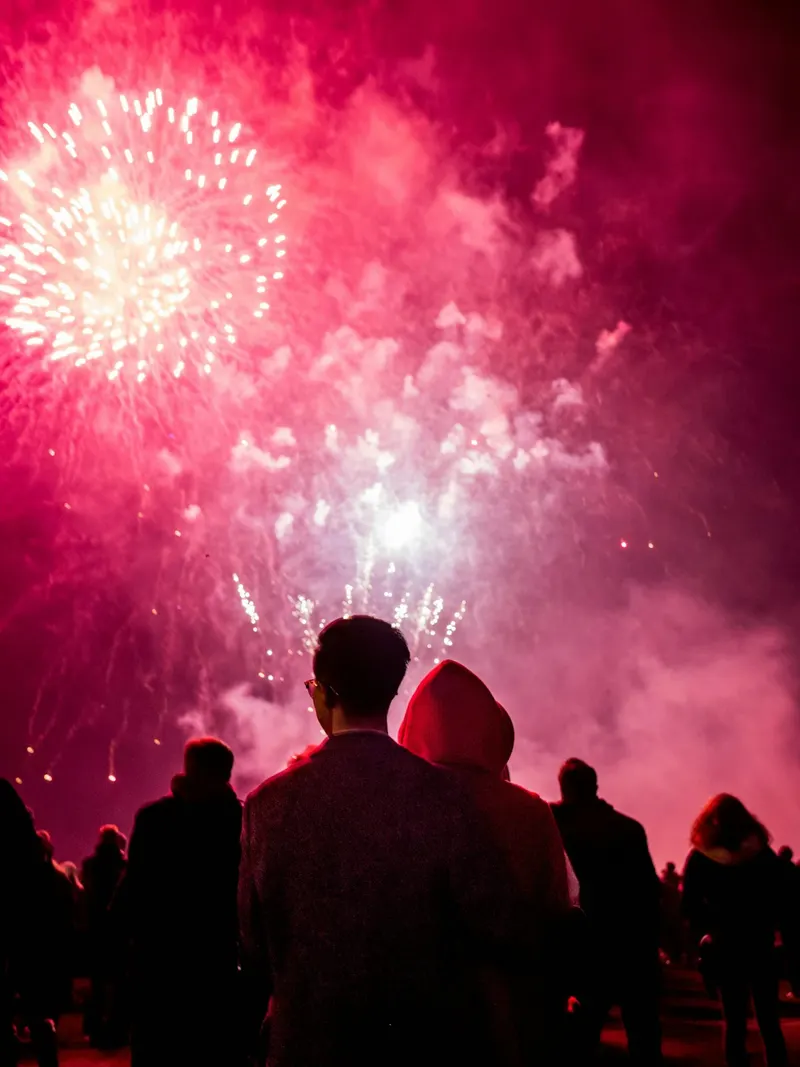
Bonfire Night has a particular smell. Woodsmoke, cold air and something sweet being eaten through a scarf. There are muddy shoes, gloves that make everything harder to hold, and someone asking whether that was the finale or whether there are more fireworks coming.
But underneath the familiar autumn evening is a rather less cosy story: religious persecution, an attempted assassination and a plot to blow up Parliament.
So why do we gather outside every November to remember it?
What is Guy Fawkes Night?
Guy Fawkes Night falls on 5 November, although local celebrations often take place on a nearby weekend. Also called Bonfire Night or Fireworks Night, it marks the failure of the Gunpowder Plot of 1605.
The original celebration was about the survival of the king and Parliament. We weren’t celebrating Guy Fawkes successfully blowing anything up. He never managed it.[1]

What actually happened in 1605?
England was ruled by James I, who was also James VI of Scotland. Religion and political power were closely tangled together, and Catholics faced restrictions and persecution under the Protestant state.
Some Catholics had hoped the new king would improve their position. When those hopes were disappointed, a small group of conspirators chose a violent response.
Led by Robert Catesby, they planned to destroy the House of Lords during the State Opening of Parliament on 5 November. The king and many of the country’s political leaders would be gathered there.
The plotters stored 36 barrels of gunpowder in a rented undercroft beneath the House of Lords. After the explosion, they hoped to launch an uprising and place the king’s young daughter, Elizabeth, on the throne.[2]
This was the scheme of a particular group, not something Catholics as a whole supported.
Where does Guy Fawkes fit in?
Despite getting his name attached to the evening, Guy Fawkes wasn’t the leader.
He was a Catholic who had served as a soldier in Europe and had experience with explosives. His job was to guard the gunpowder and set it off.
A warning letter sent to Lord Monteagle helped bring the plot to the authorities’ attention. During searches on the night of 4–5 November, Fawkes was discovered with the gunpowder and arrested.
He was imprisoned and tortured at the Tower of London. After a trial for treason, he was executed in January 1606. Other conspirators were captured or killed as the plan fell apart.[3]
It’s a grim history behind an evening we now associate with hot chocolate.
Why did it become an annual celebration?
In January 1606, Parliament passed a thanksgiving law making 5 November an annual occasion for religious services commemorating the plot’s failure.
Church bells, bonfires and fireworks became part of the observance. The law remained in force until 1859, but by then the date had become an established tradition.[1][4]
There was a darker side to those early celebrations. They often expressed anti-Catholic hostility, and effigies of the Pope were burned. Guy Fawkes later became the more familiar figure on the bonfire.[4]
Understanding that background matters, even though most families attending a display today are there for a very different sort of evening.
What was “a penny for the Guy”?
Children traditionally made a “Guy”: a stuffed figure, often assembled from old clothes, which would eventually be burned on a bonfire.
They displayed it and asked passers-by for “a penny for the Guy”. Collecting money and material for the celebrations became part of the familiar street traditions surrounding the date.[1][4]
It’s an image some readers will remember from childhood: a lumpy homemade figure, a handwritten sign and rather ambitious expectations about everyone’s spare change.


Why do we still celebrate Bonfire Night in the UK?
If you’ve wondered about our other autumn traditions, there’s also the history of pumpkins at Halloween. Its historical reason is the failure of the Gunpowder Plot. Its everyday appeal now is also seasonal: an evening outside as the nights get longer, something hot to eat, and a reason to gather with family or neighbours.
For many of us, the memories are ordinary ones. A school display. A baked potato too hot to hold. Going home smelling of smoke. Watching from the window because someone in the house hates the bangs.
The occasion has changed over the centuries, and it isn’t observed everywhere in exactly the same way. Today it can be a big organised display, a small gathering or simply a cosy evening indoors.
You don’t need a huge event to enjoy that little pause between Halloween and the rush towards Christmas.
A little history, then something warm to eat
Bonfire Night’s beginnings were political, religious and violent. The autumn ritual many families enjoy now is much more about company, food and a few lights against the dark.
And that gives us plenty to work with: affordable ways to celebrate, old-fashioned food worth bringing back, and an evening that doesn’t have to involve spending a fortune or standing in a field with an overwhelmed child.
First, though, we know why we’re remembering the fifth of November.
Sources
[1] UK Parliament: Frequently asked questions about the Gunpowder Plot.
[3] Historic Royal Palaces: Guy Fawkes and the Gunpowder Plot.