There are certain things British people are apparently incapable of walking past.
A free chair outside somebody’s house. A blackberry bush. A really good stick.
And, every September and October, a freshly fallen conker.
You can be 8 years old or 48 years old. It doesn’t matter. If you spot an absolutely magnificent, glossy, mahogany-brown conker sitting amongst the leaves, some ancient part of your brain immediately goes:
Ooooh. That’s a good one.
And into your pocket it goes.
You probably don’t need it. You may already have twelve at home. You might have absolutely no intention of playing conkers.
Still taking it.
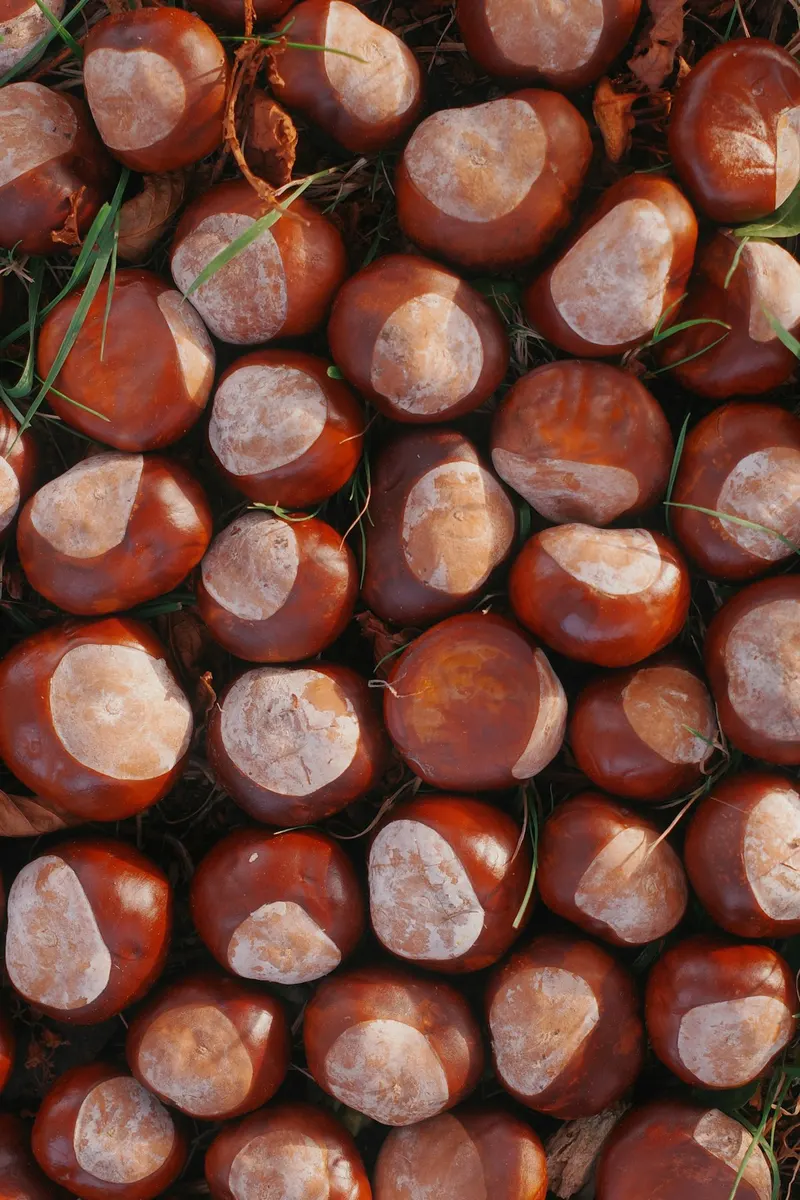
So why exactly are we all wandering around Britain every autumn collecting the seeds of a tree that isn’t even native to Britain?
Because conkers have a surprisingly lovely—and occasionally very weird—history.
First things first: what actually is a conker?
A conker is the seed of the horse chestnut tree, Aesculus hippocastanum. It ripens inside a thick green case with short spikes, which splits to reveal the shiny brown seed.
Horse chestnuts come from the Balkan Peninsula and were introduced to Britain in the late sixteenth century. They became familiar park and estate trees, and some can live for around 300 years. The enormous one in your local park may have supplied several generations’ pockets. The Woodland Trust’s horse chestnut guide has more about the tree.
And perhaps that’s part of their magic.
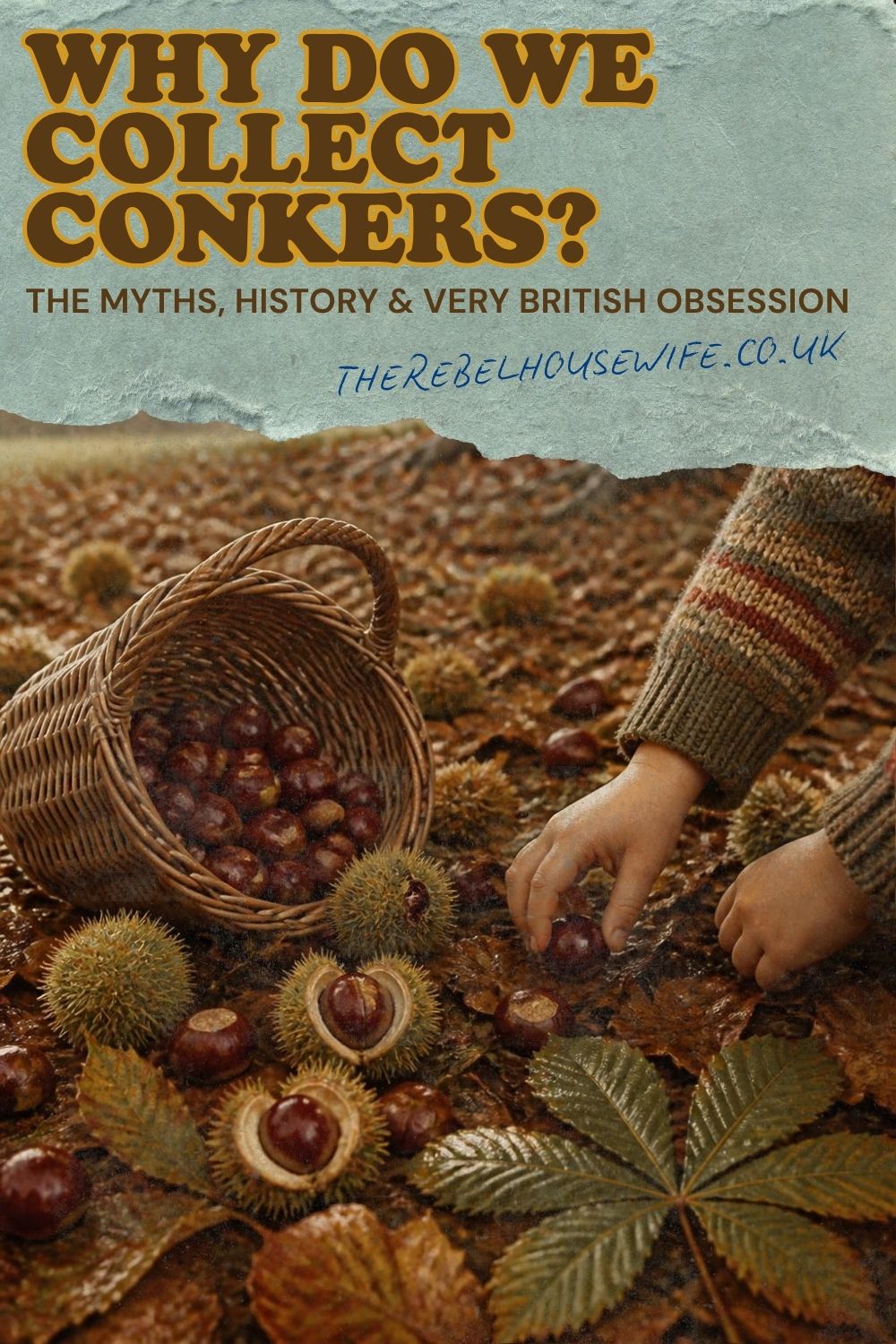
Why do we love collecting them so much?
There doesn’t need to be a practical reason. Conkers are basically nature’s collectibles.
They’re smooth. They’re shiny. They’re satisfyingly heavy in your palm. No two are quite identical.
Children instinctively start comparing them.
“Look how massive this one is.”
“Mine’s shinier.”
“I’ve got a double one!”
And adults aren’t much better.
They also mark a very specific point in the year: conkers usually ripen in September and October. The first ones beneath a tree feel like autumn officially announcing itself.
Before pumpkins appeared on every doorstep and pumpkin-spice-everything invaded our lives, these were the little treasures British children associated with autumn.
And collecting them cost absolutely nothing. Which is something I think we’ve forgotten how to appreciate.
The game of conkers is older than the conker
Here’s the odd bit. Versions of the game existed before horse chestnuts became the usual equipment. Hazelnuts and snail shells were used in earlier games; Robert Southey recalled shell games in memoirs published in 1821.
The first recorded horse-chestnut game is usually dated to 1848 on the Isle of Wight. By the later nineteenth century, conkers had become the familiar ammunition. Historic UK’s history of conkers traces that change.
The rules barely need explaining to anyone who grew up with them. Thread a conker onto string. One person holds theirs still while the other tries to absolutely annihilate it. Take turns until one breaks.
Then spend the next week telling everyone at school that yours is a six-er. Scoring traditions varied: some counted victories, while others let a winner inherit the defeated conker’s score.
There were regional names too, including cheggers, and flat-sided conkers could be called cheesers.
Naturally, generations of children also developed supposedly unbeatable hardening methods: vinegar, baking, a year in a drawer, varnish.
Basically the Victorian-child equivalent of performance-enhancing drugs. These were playground claims, though, rather than a reliable recipe for an invincible conker.
If you’re introducing children to the game, have an adult make the hole, keep fingers clear and leave plenty of space between players and spectators.
And yes, there really is a World Conker Championship
Because Britain saw two people hitting tree seeds together and naturally decided it required organised competitive governance.
The World Conker Championships began in Northamptonshire in 1965, turning playground combat into an organised competition.
So technically, when you’re wandering home from the school run with conkers rattling around in your coat pocket, you may actually be scouting future sporting equipment.
The weirdest chapter: the First World War
This one sounds made up. It isn’t.
In 1917, schoolchildren helped gather horse chestnuts for wartime acetone production. Acetone was needed to make cordite, a propellant used in ammunition. Chemist Chaim Weizmann’s fermentation process could produce it from starch, and conkers were investigated as an alternative raw material.
School records preserve the collection appeal; see the archive material in Somerset Remembers, hosted by Imperial War Museums.
Imagine that letter coming home now.
SCHOOL NOTICE
PE kit Thursday.
Reading book Friday.
Please collect several hundredweight of conkers for the explosives industry.
Different times.
The collection scheme was ultimately unsuccessful, but for a brief period the humble playground conker had a role in Britain’s wartime industrial effort.
Right. Important question. Do conkers keep spiders out of the house?
Every autumn somebody’s nan tells somebody to put conkers on the windowsill.
The theory usually goes something like this: spiders hate conkers. Sometimes it’s their smell. Sometimes it’s supposedly a chemical released by the seed. And plenty of people absolutely SWEAR it works.
There is just one slight problem. There isn’t convincing scientific evidence that it does.
The claim prompted a Royal Society of Chemistry challenge in 2009, with a £300 reward for evidence. Pupils at Roselyon School in Cornwall investigated, and their experiments found spiders quite willing to climb over conkers. In a water-escape test, most used a conker bridge rather than a wooden one.
The children received the prize in 2010. The Royal Society of Chemistry’s report describes what they tested. It’s a lovely bit of classroom science, rather than a large controlled study of household pest prevention, but it certainly gives us no reason to promise a spider-proof windowsill.
Conkers on windowsills: charming autumn decor.
Conkers as an impenetrable anti-spider forcefield: probably not.
Although if your grandma insists it works, I am absolutely not volunteering to tell her otherwise.
Where did the spider myth come from?
That’s harder to pin down. I haven’t found a reliable account of who started it.
Horse chestnuts contain saponins with soap-like properties, and they have a history of household uses. That might make chemical explanations sound plausible, but it doesn’t establish why the spider story began—or prove that it works.
My guess is that it spread the way plenty of folk advice does. Someone puts conkers beside a window. They don’t see spiders for a while. They tell somebody else. Their daughter does it. Then their granddaughter.
Eventually nobody knows who started doing it; we just know that Nan puts conkers on the windowsill because spiders don’t like them.
There’s something rather lovely about that, even when the evidence doesn’t hold up.
Other strange things people have done with conkers
The Woodland Trust records old uses, including medicinal associations, the use of saponins for washing and Victorian methods for making flour from processed seeds.
Please don’t take that as a Rebel Housewife recipe suggestion.
You should NOT eat conkers
Horse chestnuts contain toxic compounds and can cause illness if swallowed. They are different from edible sweet chestnuts, which grow on another kind of tree. Conkers can also harm pets.
So roast your sweet chestnuts. Do not roast the contents of your child’s coat pocket.
The Woodland Trust’s conker safety guide explains the distinction. Historical processing or remedy claims aren’t instructions for eating them or treating yourself with them.
What can we actually do with all the conkers we’ve collected?
If your children operate like mine—or you’re secretly the collector—you’ll probably end up with an inexplicably enormous bowl of them by mid-October.
Fortunately, that’s basically a free autumn craft box.
- Traditional conkers: teach older children the playground game, with adult help preparing them.
- Little conker creatures: add twigs, wool or other collected materials.
- Autumn counting: sort by size, count, weigh and arrange, with supervision.
- Conker painting: put paper in a shallow tray, add paint and roll the conkers around to make patterns.
- An autumn nature bowl: mix them with pine cones, leaves and other treasures from your walks.
- Nature journalling: draw the conker, its case, the leaf and its tree.
Keep them away from pets and children who might put them in their mouths; they’re also a choking hazard. Dry your finds before displaying them and discard any that go mouldy.
For more ways to use your walk’s treasures, have a rummage through these simple autumn nature crafts.
Maybe collecting them is the point
I think this is the bit I like most.
We live in a world where autumn has become another thing we’re encouraged to buy.
Buy the autumn candle. Buy the pumpkin mug. Buy the decorative velvet pumpkins. Buy the seasonal cushions. Buy seventeen tiny ceramic ghosts immediately because apparently they’ll disappear forever on 1 November.
And look—I am hardly immune to a tiny ceramic ghost.
But autumn used to come with its own decorations. Conkers. Acorns. Pine cones. Beech nuts. Leaves. Interesting sticks. Things children shoved into their pockets and brought home damp from the park.
Collecting conkers is one of those tiny remnants of an older, slower way of noticing the seasons.
You have to go outside. You have to find the tree. You have to look underneath it.
And when you find that freshly opened green shell with a completely untouched glossy conker sitting inside it, you still get the same ridiculous little thrill children have probably felt for generations.
You don’t need it. You don’t even know what you’re going to do with it.
But you’re taking it home. Obviously.
If you like finding the stories behind our autumn rituals, here’s why we put pumpkins on the doorstep at Halloween. And if seasonal expectations are getting a bit much, try autumn without the performance.
A little Rebel Housewife reminder: conkers aren’t edible. Enjoy collecting and crafting with them, but keep them out of mouths—human or otherwise.
