The fridge dial says three. Three what, exactly? Three degrees? Three notches away from freezing the cucumber? A setting somebody chose when you moved in and nobody has questioned since?
For an appliance we trust with the milk, the leftovers and whatever is wrapped in that little bit of foil, the fridge can be surprisingly mysterious.
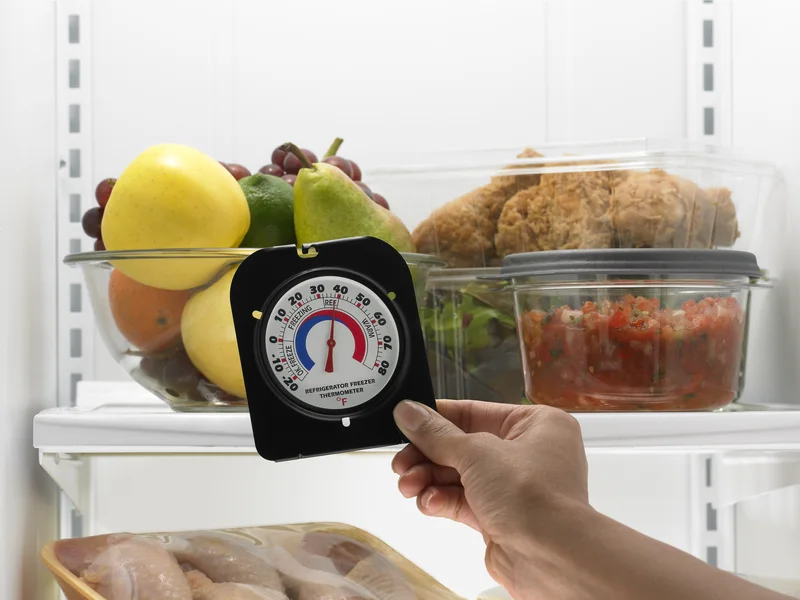
This week’s Emergency Cupboard addition is a simple fridge thermometer. It earns its place on an ordinary Tuesday, then gives you something useful to check if a power cut interrupts the kitchen routine.
Start with the fridge you already have
Before buying anything, check the manual or look up your model. Some fridges have a display that shows the measured temperature. Others show the temperature you’ve asked them to reach. A numbered control dial is another thing again.
That little distinction is worth sorting out while the lights are on and you have a cup of tea within reach.
Food Standards Scotland recommends keeping the fridge between 0°C and 5°C, checking it regularly with a thermometer. Its guidance also explains that the numbers on a conventional control dial don’t represent degrees Celsius. Food Standards Scotland’s chilling guidance
If you need a separate thermometer, choose one designed for fridge use, with numbers you can comfortably read. Follow its instructions for positioning it and allowing the reading to settle. Give it a spot where you can see it without excavating three jars of chutney.
Learn what normal looks like
Have a look during your usual kitchen routine. You could pair it with putting the milk away or checking what needs using before the next shop.
If the reading falls outside the recommended range, follow the fridge manufacturer’s instructions to adjust the setting, then check again after allowing it to settle. Food Standards Scotland also advises leaving room for air to circulate and keeping door openings brief. Food Standards Scotland’s fridge advice
There is something reassuringly old-fashioned about this. A small instrument, a quick glance and a bit of attention to the things already in the house. It belongs in the same kitchen as the biscuit tin full of buttons and the pencil kept beside the shopping list.
When the lights go out
Write down when the power stopped, if you know. Keep fridge and freezer doors closed as much as possible. The Food Standards Agency estimates that a closed fridge stays cold for up to four hours, although appliances and conditions vary.
When you need to check, note the time and temperature. Use those details alongside the official advice. Both food standards agencies advise that chilled food can stay in the fridge while the temperature remains below 8°C during a power cut. If it reaches 8°C or higher, use food that normally needs refrigeration within four hours. A first reading of 8°C or higher may come after the fridge has already warmed up. Follow the guidance for your part of the UK to decide what to keep or discard. England, Wales and Northern Ireland power-cut guidance · Scotland power-cut guidance
If the power returns before you check, a cold reading later cannot reconstruct what happened earlier. Leave unknown times blank on your notes. If you’re unsure how long food has been warm, seek advice from your local council’s food-safety team.
Leave a note beside the shopping list
Keep a pencil and a small piece of paper somewhere easy to find. Write the power-off time at the top, then any readings you actually take.
If someone else takes over in the kitchen, they’ll have the same information you do. Nobody has to try to remember whether the lights went out before the school run or after you put the washing on.
Our A5 Fridge-door note gives those scribbles a home. It has room for the power-off and power-back times, three temperature checks and a note of what you did next.
Download the fridge-door note (A5 PDF)
The five-minute version
Find out what your fridge’s dial or display is telling you. Check that you can measure the actual temperature. Put a pencil beside the shopping list.
Then carry on with your day. One small job ticked off, with absolutely no requirement to reorganise the entire fridge while you’re there.
For the rest of the kitchen plan, read our family power-cut guide. And if your backup meal lives in a tin, make sure the tin opener has a home too.
Share this with the person who also thought the fridge dial was a temperature reading.