The Rebel Housewife · Film, nostalgia & cult classics
25 Years of Mulholland Drive: David Lynch’s Beautiful, Baffling Hollywood Nightmare
A love letter to Lynch’s Hollywood nightmare, from the audition scene to the blue box and everything that refuses to leave my head.
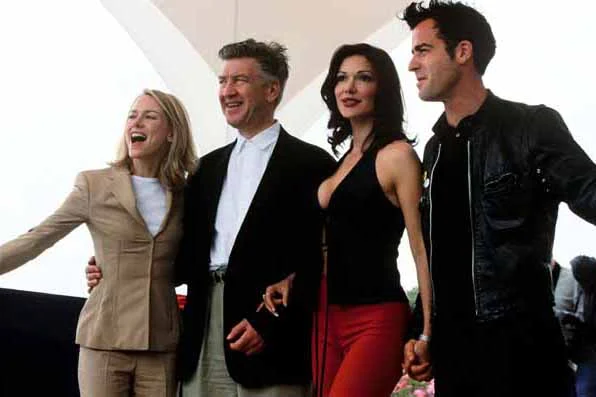

Twenty-five years ago today, on 19 October 2001, Mulholland Drive expanded into wider release in American cinemas, following its limited opening on 12 October, and David Lynch gave us one of the strangest, most beautiful and thoroughly unsettling films ever made.
And I bloody love it.
Now, if you're looking for a film with a straightforward plot, a nice tidy ending and someone helpfully explaining what the hell just happened, I'm afraid you've come to the wrong place.
This is David Lynch we're talking about.
The man who could make a perfectly ordinary suburban street feel like the entrance to hell. The man who gave us Twin Peaks, Blue Velvet, Eraserhead and Lost Highway. A filmmaker who understood that sometimes the most frightening thing imaginable isn't a monster or a murderer.
Sometimes it's a perfectly normal-looking person smiling at you for slightly too long.
And Mulholland Drive might just be his masterpiece.
Welcome to Hollywood. Don't Trust Anybody.
The film begins with a mysterious brunette woman (Laura Harring) surviving a horrific car accident on Mulholland Drive, the winding road overlooking Los Angeles.
Disoriented, injured and unable to remember who she is, she takes refuge in an apartment where she meets Betty Elms (Naomi Watts), an impossibly cheerful aspiring actress who has just arrived in Hollywood.
Betty is all bright eyes, enthusiasm and old-fashioned Hollywood optimism. She's the sort of woman who genuinely believes she's about to become a movie star.
And honestly, for the first little while, you almost believe it too.
The mysterious woman adopts the name Rita, borrowed from a poster of Rita Hayworth, and the two women set about trying to uncover her identity.
So far, so relatively normal.
Except this is Lynch, and somewhere along the way we find ourselves dealing with a terrifying figure behind a diner, a deeply peculiar cowboy, sinister Hollywood executives, a mysterious blue key and a nightclub that might just contain the answer to everything.
Or absolutely nothing.
And just when you think you've worked out what's happening, the film pulls the rug from underneath you.
Then sets fire to the rug.
Then asks whether there was ever a rug in the first place.
Why I Love David Lynch
There is something about Lynch's work that I find completely irresistible.
It's the atmosphere. The strange little details. The uncomfortable silences. The way he makes ordinary places feel profoundly wrong.
His films remind me of dreams I've had where everything looks familiar, but something isn't quite right. You recognise the house, the people, the street, but you know you shouldn't be there.
That's what Lynch does better than almost anybody.
He creates a world that feels both nostalgic and deeply sinister.
There's often something wonderfully old-fashioned about his work, too. The clothes, the music, the diners, the interiors. That romanticised mid-century America, with its immaculate lawns, beautiful women and smiling faces.
And then he peels back the wallpaper.
Underneath all that loveliness is something rotten.
Mulholland Drive captures this perfectly. Hollywood is presented as a glamorous dream factory, but behind the beautiful faces and palm trees lies jealousy, desperation, manipulation and heartbreak.
It's a love letter to cinema and a warning about it, all at once.
And that's precisely the sort of contradiction I adore.
The Cast: Naomi Watts Is Absolutely Extraordinary
We need to talk about Naomi Watts.
Because, good grief, what a performance.
Watts plays Betty with this almost exaggerated sweetness. At first, she seems like she's wandered straight out of a 1950s Hollywood romance.
But then comes the audition scene.
If you've seen it, you know exactly what I'm talking about.
Watching Betty transform from a slightly awkward, wide-eyed newcomer into someone utterly magnetic is extraordinary.
And that's before we even get to the rest of her performance.
It's difficult to discuss exactly why she's so brilliant without giving away enormous parts of the film, but the emotional range she demonstrates is staggering.
It's no wonder this became her breakthrough role.
Laura Harring is equally captivating as Rita. She's glamorous, mysterious, vulnerable and slightly otherworldly. She looks as though she belongs in a classic Hollywood noir, which is entirely the point.
Interestingly, Harring later recalled that Lynch wanted her character to feel as though a frightening dark cloud was constantly following her. Once you know that, you can practically feel it hanging over every scene. [1]
Then there's Justin Theroux as film director Adam Kesher, whose professional and personal life begins falling apart in increasingly bizarre ways.
He's brilliant at conveying the frustration of a man who has absolutely no idea why the universe has suddenly decided to ruin his day.
And we mustn't forget the supporting cast.
Ann Miller, a genuine star of Hollywood's golden age, plays Coco. Robert Forster appears as a detective. Michael J. Anderson, familiar to Twin Peaks fans, plays the mysterious Mr. Roque.
Even composer Angelo Badalamenti pops up as a particularly unpleasant espresso-drinking film executive.
It's an extraordinary collection of faces, and Lynch somehow makes every single one feel significant, even when they're on screen for only a few minutes.
The Film That Was Never Supposed to Be a Film
Here's one of my favourite pieces of Mulholland Drive history.
It wasn't originally supposed to be a film at all.
Lynch had developed it as a television series for ABC, the American network that had previously broadcast Twin Peaks.
A pilot was filmed in 1999, introducing the characters and setting up various mysteries that would presumably unfold over subsequent episodes.
Except ABC didn't want it.
Imagine being the people who rejected Mulholland Drive.
I mean, admittedly, I can understand why a television executive might watch it and wonder what on earth they were supposed to do with it.
But still.
Thankfully, French financing from StudioCanal allowed Lynch to return to the project, shoot additional material and transform the abandoned pilot into a feature film.
And in one of cinema's loveliest little ironies, that rejected television project became one of the most celebrated films of the 21st century.
It premiered at Cannes in May 2001, where Lynch shared the Best Director prize with Joel Coen for The Man Who Wasn't There.
Lynch also received an Academy Award nomination for Best Director.
Not bad for something that had effectively been thrown in the bin by a television network.
The Diner Scene. Oh, THAT Diner Scene.
I cannot write about Mulholland Drive without mentioning Winkie's diner.
You know the scene.
Two men sit in a perfectly ordinary diner discussing a nightmare. One describes a terrifying figure he believes is lurking behind the building.
Nothing particularly frightening has happened.
Yet.
But the dread is almost unbearable.
Lynch builds tension through conversation, pacing, sound and the simple knowledge that something dreadful might be waiting around the corner.
And then...
Well.
If you've never seen the film, I'm not spoiling it.
But I will say that this scene remains one of the most effective scares I've ever experienced in a film.
It's proof that you don't need elaborate special effects, buckets of blood or a masked lunatic chasing somebody through the woods.
Sometimes all you need is a wall, a face and an audience that has been made to feel very, very uncomfortable.
Club Silencio: One of the Most Beautiful Scenes in Cinema
And then there's Club Silencio.
God, I love this scene.
It's eerie, theatrical, heartbreaking and completely mesmerising.
Without revealing too much, Betty and Rita visit a strange nightclub where a performer explains that what they're hearing isn't necessarily what they think they're hearing.
Then singer Rebekah Del Rio performs a Spanish-language version of Roy Orbison's Crying, titled Llorando.
It is absolutely devastating.
There's something about that performance that gets right under my skin.
The lighting. The curtains. The music. The overwhelming sense of sadness.
And the feeling that something terribly important is happening, even if you can't quite explain what.
One of my favourite pieces of trivia is that Del Rio's vocal was recorded almost by accident.
She visited Lynch's recording studio, intending to meet him and sing. Lynch later explained that the spontaneous recording made that morning became the actual vocal used in the film. [2]
I love that.
Something so haunting, so perfectly suited to the film, came from a chance meeting.
Very Lynch, really.
A Few Wonderful and Weird Mulholland Drive Facts
Because I do love a bit of film trivia.
- Lynch provided ten clues to the mystery. They appeared with a DVD release, encouraging viewers to pay attention to seemingly insignificant details, including a red lampshade, a coffee cup and the mysterious events at Winkie's.
- Angelo Badalamenti played Luigi Castigliane. Yes, the same man responsible for some of Lynch's most haunting music is the chap who dramatically rejects his espresso.
- Laura Harring and Naomi Watts were chosen from photographs. Lynch's casting process was famously intuitive, and both actresses made an immediate impression.
- The film is dedicated to Jennifer Syme. She was a young actress and former Lynch production assistant who died in a car accident in 2001.
- There's a connection to Sunset Boulevard. Lynch's fascination with old Hollywood runs throughout the film, including visual references to Billy Wilder's 1950 classic.
- The original television pilot left several storylines open. Which helps explain why certain characters and mysteries appear briefly before disappearing.
- It topped the BBC's 2016 poll of the greatest films of the 21st century. A remarkable achievement for a film that initially struggled to find a home.
So, What Does Mulholland Drive Actually Mean?
This section discusses the film’s shifting identities and ending. Skip to the next section →
Ah, the million-dollar question.
There are countless interpretations of Mulholland Drive, and I'm not convinced there's one definitive answer.
The most popular theory is that much of the film takes place inside Diane Selwyn's imagination, with Betty representing an idealised version of herself.
A version who is talented, optimistic, loved and destined for success.
Rita becomes a reimagining of Camilla Rhodes, the woman Diane loves, while the strange characters and events represent distorted versions of real people, experiences, fears and regrets.
The Hollywood dream becomes exactly that.
A dream.
And reality is far less kind.
Underneath all the surrealism, I think there's something desperately sad about Mulholland Drive.
It's about wanting a different life.
Wanting to be somebody else.
Wanting somebody to love you.
And discovering that the world doesn't always give us the endings we imagine for ourselves.
The blue box, the key, the shifting identities — they're fascinating to analyse, but I'm not sure we're supposed to solve everything.
Lynch himself was famously reluctant to explain the meaning of his work, preferring to leave room for viewers to experience and interpret it.
And I rather like that.
Because sometimes art is more interesting when it refuses to tell you what to think.
Why It Still Matters 25 Years Later
Twenty-five years later, Mulholland Drive feels just as hypnotic and unsettling as ever.
Perhaps even more so.
We live in a world obsessed with appearances, carefully curated identities, celebrity, fame and the promise that success will somehow make everything better.
And here's a film from 2001 quietly reminding us that the dream can become a nightmare.
It's also a reminder of what cinema can be when a director is allowed to follow their own strange imagination.
Not everything has to be explained.
Not every character needs a neat backstory.
Not every mystery needs solving.
Sometimes it's enough to sit in the dark for two and a half hours, become completely absorbed in somebody else's bizarre little universe, and emerge feeling like your brain has been rearranged.
That's cinema.
And that's David Lynch.
Remembering David Lynch
Of course, this anniversary feels particularly poignant because Lynch is no longer with us.
He died in January 2025, aged 78, leaving behind an extraordinary body of work and a creative legacy that will continue to influence filmmakers, artists and odd little souls like me for generations.
There really was nobody quite like him.
He made the mundane terrifying, the grotesque beautiful and the inexplicable strangely moving.
His films weren't designed to appeal to everybody, and I think that's part of what makes them so special.
He never seemed particularly interested in making things ordinary.
Thank goodness.
Because the world would be a far less interesting place without red curtains, mysterious strangers, ominous electrical buzzing and that peculiar feeling that something dreadful is happening just out of sight.
My Verdict: A Beautiful Nightmare Worth Revisiting
5/5 — ★★★★★
Is Mulholland Drive an easy watch?
Absolutely not.
Will you understand everything that's happening?
Probably not.
Will you spend the next three days thinking about a blue box, a cowboy and a woman singing in a nightclub?
Quite possibly.
And that's why I love it.
Some films entertain you for a couple of hours and then disappear from your memory.
Others take up permanent residence somewhere in the back of your mind.
Mulholland Drive is definitely the latter.
Happy 25th anniversary to one of cinema's most beautiful nightmares.
And thank you, David Lynch, for making the world a little bit weirder.
Silencio.
Sources & further reading
- Laura Harring on Lynch, casting and the dark cloud — BFI
- Lynch on Mulholland Dr., the pilot and Rebekah Del Rio — Criterion
- 2001 film credits and Best Director award — Festival de Cannes
- 2002 directing nomination — Academy Awards
- 20th anniversary and the StudioCanal rescue — CANAL+
- BBC Culture’s 2016 poll of 21st-century films
- Remembering David Lynch — BFI